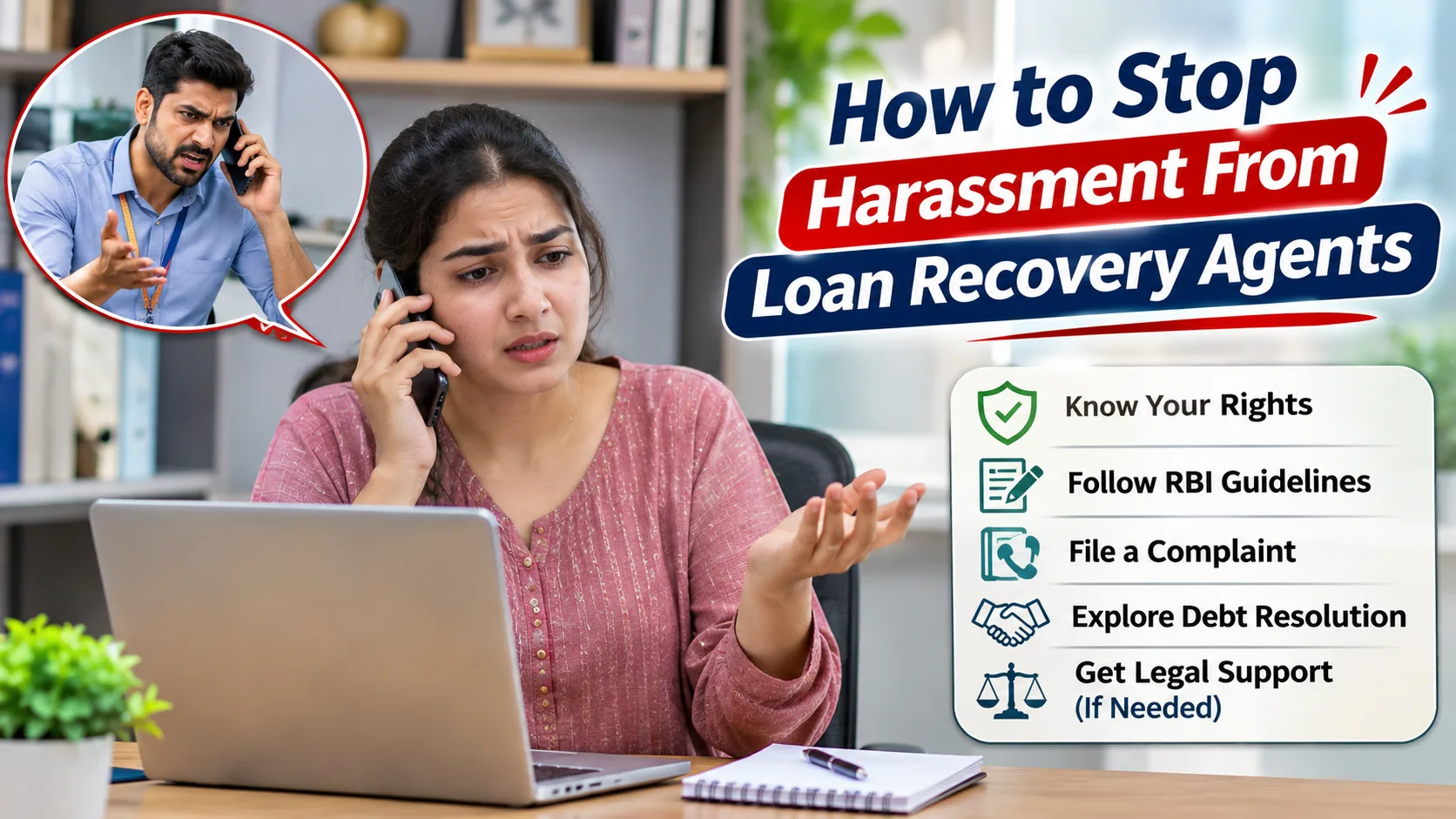
Are loan recovery agents calling you repeatedly, threatening legal action, visiting your home, or contacting your family members over unpaid EMIs?
Financial difficulties are stressful enough without aggressive recovery calls adding to your worries. Whether you have an overdue personal loan, credit card balance, business loan, or digital loan, you have the right to be treated with dignity during the debt recovery process.
Banks and Non-Banking Financial Companies (NBFCs) have the right to recover legitimate outstanding dues, but they cannot use intimidation, abusive behaviour, or unlawful pressure to collect payments.
If you are searching for how to stop harassment from loan recovery agents in India, this guide explains your rights, RBI recovery guidelines, complaint procedures, legal remedies, and practical steps to address inappropriate recovery behaviour while managing your outstanding debt responsibly.
How to Stop Loan Recovery Agent Harassment: Quick Answer
To address loan recovery agent harassment in India:
-
Verify the recovery agent's identity and lender authorisation.
-
Preserve threatening messages, call logs, and evidence of inappropriate visits.
-
Submit a written complaint to the concerned bank or NBFC.
-
Escalate unresolved eligible complaints through the RBI Complaint Management System (CMS).
-
Contact the police if you experience criminal threats, violence, or immediate danger.
-
Seek legal assistance from a qualified advocate when necessary.
-
Discuss affordable repayment alternatives directly with your lender.
Remember, filing a harassment complaint does not automatically cancel your outstanding loan or suspend lawful recovery proceedings.
What Is Loan Recovery Agent Harassment?
Loan recovery agent harassment occurs when a lender's representative uses abusive, threatening, misleading, excessively intrusive, or otherwise inappropriate methods to recover outstanding debt.
A genuine payment reminder is not necessarily harassment. Lenders are entitled to communicate with borrowers regarding overdue payments.
However, recovery activities must comply with applicable regulatory requirements and legal protections.
Examples of inappropriate recovery practices may include:
-
Repeated and intimidating telephone calls.
-
Abusive language or threats of physical harm.
-
Public humiliation or deliberate embarrassment.
-
Inappropriate disclosure of loan information to relatives or colleagues.
-
Threatening WhatsApp messages or social media communication.
-
Aggressive visits to a borrower's home or workplace.
-
False claims about immediate arrest or property seizure.
-
Demands for payments through unverified personal accounts.
Borrowers should document the specific behaviour rather than assume every recovery communication is unlawful.
Why Do Loan Recovery Agents Contact Borrowers?
When borrowers miss scheduled EMIs or credit card payments, lenders may assign accounts to internal collections teams or authorised recovery agencies.
Recovery representatives may contact borrowers to discuss outstanding dues, understand repayment difficulties, and communicate available payment arrangements.
Common reasons for recovery communications include:
-
Overdue personal loan EMIs.
-
Unpaid credit card bills.
-
Defaulted bank or NBFC loans.
-
Missed digital loan repayments.
-
Unpaid business loan instalments.
-
Breach of an agreed repayment arrangement.
However, outsourcing debt collection does not remove the lender's responsibility for the conduct of its authorised representatives.
RBI Guidelines for Loan Recovery Agents in India (2026)
The Reserve Bank of India establishes regulatory requirements concerning debt recovery practices, customer protection, outsourcing, and grievance redressal.
The recovery safeguards introduced through RBI's August 2022 circular have been incorporated into the subsequent consolidated regulatory directions for relevant lender categories.
Under applicable RBI directions, regulated lenders and their recovery representatives must avoid intimidation, unfair pressure, and inappropriate interference with borrowers' privacy.
What Are the Permitted Calling Hours for Recovery Agents?
For overdue loans covered by the general RBI recovery-contact restrictions, recovery calls should not be made before 8:00 AM or after 7:00 PM.
Microfinance loans are governed by separate recovery requirements, including different calling-hour restrictions.
Persistent or intimidating calls may also be inappropriate even when made within permitted hours.
Can Recovery Agents Threaten or Abuse Borrowers?
No. Recovery representatives must not use physical intimidation, abusive behaviour, fabricated legal consequences, or humiliating collection tactics.
Borrowers can raise complaints concerning such conduct with the responsible lender.
Are Banks Responsible for Recovery Agent Behaviour?
Yes. Regulated lenders remain responsible for outsourced recovery activities.
Appointing a third-party recovery agency does not remove the lender's regulatory accountability for the collection process.
8 Practical Steps to Stop Harassment From Loan Recovery Agents
If you are experiencing inappropriate recovery behaviour, following a documented approach can help you pursue an effective complaint.
Step 1: Verify the Recovery Agent's Identity
When someone contacts you claiming to represent a bank or NBFC, request their name, recovery agency details, lender information, and relevant authorisation.
For an in-person visit, ask for identification and the lender's authorisation documents.
Confirm these details independently through the lender's official customer support channel.
Never share banking passwords, OTPs, or card credentials with a recovery representative.
Verification is particularly important when someone demands immediate payment through an unfamiliar account.
Step 2: Collect Evidence of Recovery Agent Harassment
A clear record can strengthen your complaint and help the lender investigate the incident.
Preserve relevant evidence, including call logs, SMS messages, WhatsApp screenshots, emails, visit details, witness information, and previous complaint acknowledgements.
Where lawful and appropriate, relevant call recordings may also help establish what occurred.
Maintain a dated record describing the agent's conduct, including the exact nature of any threats.
Avoid editing original evidence or publishing sensitive loan information on social media.
Step 3: Communicate Calmly and Request Written Communication
Respond professionally and avoid arguments or retaliatory threats.
Inform the recovery representative that you are willing to communicate regarding legitimate outstanding dues but object to inappropriate behaviour.
You may request that important repayment discussions and payment demands be communicated through official written channels.
For example:
"I am willing to discuss my outstanding loan through the lender's authorised channels. Please communicate the account details and repayment options in writing and refrain from threatening or inappropriate conduct."
Requesting written communication does not automatically prevent all legitimate recovery contact, but it can help establish a reliable record.
Step 4: File a Written Complaint With Your Bank or NBFC
Contact the lender's official grievance redressal department and explain what happened.
Your complaint should include:
-
Your loan account reference.
-
Recovery agent or agency details.
-
Dates and times of relevant incidents.
-
A factual description of the inappropriate conduct.
-
Supporting documents and evidence.
-
The corrective action you are requesting.
Request a complaint acknowledgement or reference number.
Where necessary, escalate the matter to the lender's designated grievance or nodal officer.
Step 5: Escalate Your Complaint to the RBI Ombudsman
If an eligible complaint remains unresolved or you receive an unsatisfactory response, you may approach the RBI Ombudsman through the official Complaint Management System at cms.rbi.org.in.
The Reserve Bank – Integrated Ombudsman Scheme, 2026, became effective on 1 July 2026, replacing the previous 2021 scheme.
Under the updated framework, you must first approach the concerned regulated entity. If no response is received within 30 days, or a longer applicable regulatory period, you may be eligible to escalate. An unsatisfactory response can also permit escalation before that period expires.
Complaints must generally be submitted within 90 days of the relevant response deadline or the lender's last communication, whichever is later.
Filing an eligible RBI Ombudsman complaint is free.
Step 6: Approach the Police in Serious Situations
If recovery agents engage in criminal intimidation, physical violence, forced entry, extortion, or serious threats, consider approaching the police.
Preserve evidence and explain the specific incident.
If you face immediate physical danger, contact India's emergency helpline at 112.
You do not need to wait for the lender's complaint process to conclude before seeking urgent police protection.
Step 7: Seek Professional Legal Support When Necessary
Some recovery situations involve legal notices, disputed outstanding balances, privacy violations, or repeated inappropriate conduct.
Borrowers requiring structured guidance can explore LoanCureSolutions' recovery agent harassment support services to understand complaint options, organise evidence, review lender communications, and access legal support through qualified advocates where appropriate.
The appropriate legal remedy depends on the circumstances, available evidence, and applicable law.
Step 8: Address the Underlying Repayment Difficulty
While raising a harassment complaint is important, the outstanding debt may still require resolution.
Review your income, essential expenses, overdue EMIs, and available repayment capacity.
Depending on your situation, you may discuss revised repayment terms, restructuring, or a negotiated settlement with your lender.
If regular personal loan repayments have become unaffordable, read our detailed guide on how to negotiate personal loan settlement with a bank in India to understand negotiation strategies, documentation requirements, lender approval, and potential credit consequences.
Loan Recovery Agent Harassment Complaint Letter Format
Subject: Formal Complaint Regarding Inappropriate Loan Recovery Agent Conduct
Dear Sir/Madam,
I am writing to raise a formal complaint concerning the conduct of a recovery representative claiming to act on behalf of your organisation regarding my loan account [Account Reference].
On [Date and Time], I received inappropriate recovery communication involving [Describe the Incident].
I request that your grievance department investigate this matter, take appropriate corrective action, and ensure future recovery communications comply with applicable RBI directions.
I am prepared to communicate regarding legitimate outstanding dues through authorised channels.
Relevant supporting evidence is attached for your review.
Please acknowledge this complaint and provide a written response.
Regards,
[Your Name]
[Registered Contact Details]
[Date]
Can Recovery Agents Visit Your Home or Workplace?
An authorised recovery representative may contact or visit a borrower in accordance with applicable recovery requirements.
However, a visit does not give the representative unrestricted authority to enter private premises, threaten occupants, or publicly disclose sensitive financial information.
If a recovery agent visits your home, request identification and authorisation, remain calm, and verify the purpose of the visit.
If the representative becomes aggressive or refuses to leave in threatening circumstances, prioritise personal safety and seek appropriate police assistance.
Workplace visits involving humiliation or inappropriate disclosure of debt information may also warrant a complaint.
Can Loan Recovery Agents Contact Family Members or Friends?
Recovery agents must respect applicable privacy and confidentiality requirements.
Contacting an individual merely to locate a borrower differs from disclosing confidential debt information, threatening relatives, or pressuring unrelated individuals to repay a loan.
Family members and friends are not automatically responsible for your outstanding debt simply because they are listed as references.
However, co-borrowers and guarantors may have contractual repayment obligations.
If someone contacts your relatives inappropriately, document the communication and raise the matter with the lender.
What to Do If Digital Loan App Recovery Agents Harass You
Borrowers using instant loan applications may encounter threatening messages, inappropriate use of personal information, or pressure involving their phone contacts.
First, identify the actual bank or NBFC that issued the loan. The application itself may only act as a lending service provider.
Preserve relevant screenshots, check unnecessary app permissions, and raise a complaint with the responsible lender.
If the incident involves blackmail, online threats, identity misuse, or cybercrime, consider reporting it through India's National Cyber Crime Reporting Portal at cybercrime.gov.in.
For suspected financial cyber fraud, contact 1930 promptly.
Legal Recovery vs Recovery Agent Harassment
Understanding the distinction between lawful recovery and inappropriate behaviour can help you respond effectively.
| Legitimate Recovery | Potential Harassment |
|---|---|
| Reasonable payment reminders | Persistent intimidating calls |
| Verified recovery communication | Threatening or anonymous calls |
| Authorised visits following applicable rules | Aggressive visits or forced entry |
| Genuine legal notices | Fabricated arrest threats |
| Official repayment proposals | Demands through unverified accounts |
| Appropriate confidential communication | Public humiliation or privacy violations |
A borrower can challenge inappropriate conduct without denying legitimate repayment obligations.
How LoanCureSolutions Helps Borrowers Facing Recovery Pressure
LoanCureSolutions provides structured debt-resolution guidance for borrowers experiencing repayment difficulties and recovery-related concerns across India.
Depending on individual circumstances, assistance may include reviewing recovery communications, organising complaint evidence, understanding lender responses, evaluating affordable repayment alternatives, and providing legal support through qualified advocates where required.
Borrowers in Delhi, Mumbai, Bengaluru, Hyderabad, Pune, Chennai, Kolkata, Ahmedabad, and other Indian cities may seek guidance based on their individual financial circumstances.
Our approach focuses on understanding the account, addressing concerning recovery practices, and exploring realistic resolution options rather than promising guaranteed debt waivers or an immediate end to all recovery calls.
Frequently Asked Questions About Loan Recovery Agent Harassment
1. How can I stop harassment from loan recovery agents in India?
Document inappropriate conduct, verify the representative, complain to the lender, and escalate through appropriate regulatory or legal channels when necessary.
2. Where can I complain about loan recovery agent harassment?
Start with your bank or NBFC grievance department. Eligible unresolved complaints may be escalated to the RBI Ombudsman.
3. Can recovery agents call me after 7 PM?
For loans covered by general RBI calling-hour restrictions, recovery calls after 7 PM are prohibited. Separate requirements apply to certain loan categories.
4. Can recovery agents call me multiple times a day?
Persistent calling may violate applicable recovery safeguards. The frequency, purpose, and nature of communication are relevant.
5. Can a recovery agent threaten me with arrest?
Recovery agents cannot arrest borrowers. False arrest threats may warrant a complaint. Genuine criminal allegations or court proceedings require separate legal assessment.
6. Can recovery agents visit my home without permission?
Authorised visits may be permissible, but agents cannot forcibly enter your home, threaten you, or disregard applicable legal requirements.
7. Can I file a police complaint against recovery agents?
Yes. Criminal intimidation, violence, extortion, and other potentially unlawful conduct may be reported to the police.
8. Can recovery agents contact my employer?
Workplace contact must comply with applicable privacy and recovery requirements. Inappropriate disclosure or humiliation may warrant a complaint.
9. Can recovery agents contact my family members?
Agents must respect privacy safeguards. Relatives who are not borrowers or guarantors are not automatically responsible for your debt.
10. Can I block loan recovery agent calls?
You may block abusive or suspicious numbers, but maintain an official communication channel with your lender and do not ignore genuine notices.
11. How do I file an RBI complaint against a recovery agent?
First, complain to the responsible lender. If eligible, escalate the unresolved grievance through the RBI CMS portal.
12. What is the RBI complaint helpline number?
RBI's contact centre number is 14448. It provides complaint-related guidance, but complaints cannot be formally lodged through the helpline itself.
13. Can I claim compensation for recovery agent harassment?
Compensation may be available through eligible regulatory or legal proceedings, depending on the facts, evidence, and applicable requirements.
14. Can recovery agents seize my property for an unpaid personal loan?
Recovery representatives cannot arbitrarily seize property. Any lawful enforcement action must follow applicable contractual and legal procedures.
15. Does filing a harassment complaint stop loan interest?
No. Filing a complaint does not automatically freeze interest, charges, repayment obligations, or legitimate recovery activities.
16. Can a loan recovery agent send WhatsApp messages?
Legitimate recovery communication may be permissible, but abusive messages, threats, inappropriate disclosures, and misleading demands are not acceptable.
17. Can I negotiate loan settlement after recovery harassment?
Yes. You may independently request settlement or revised repayment arrangements. Approval depends on the lender's assessment.
18. Can a lawyer help stop recovery agent harassment?
A qualified advocate can assess potential violations, explain available legal remedies, and assist with appropriate legal responses.
19. Can NBFC recovery agents harass borrowers over missed EMIs?
No. Applicable RBI directions require regulated NBFCs and their representatives to follow appropriate collection practices.
20. Does loan default mean I lose my borrower rights?
No. Missing loan repayments does not remove your rights to privacy, fair treatment, personal safety, and appropriate grievance redressal.
Final Thoughts: Protect Your Rights Without Ignoring Your Debt
Dealing with overdue loans can be emotionally and financially challenging, particularly when recovery communications become aggressive.
Understanding how to stop harassment from loan recovery agents begins with knowing your rights, preserving evidence, communicating through official channels, and pursuing appropriate complaint procedures.
At the same time, addressing the underlying repayment problem can help you work toward a more sustainable financial solution.
You have the right to fair treatment, even when you are experiencing financial difficulties.