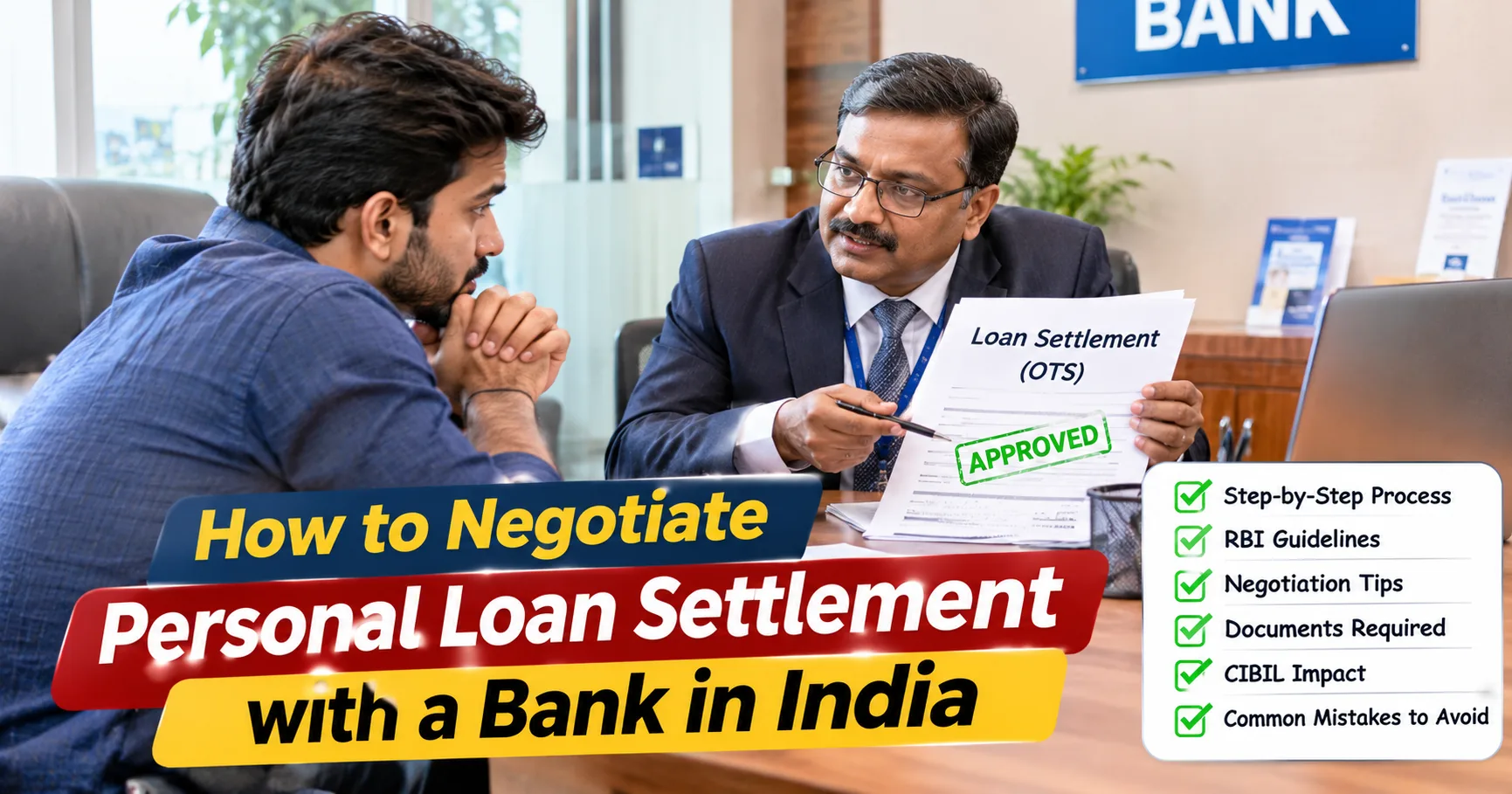
Are you struggling with overdue personal loan EMIs, increasing interest charges, and frequent recovery calls? If your financial circumstances have changed and regular repayments are no longer affordable, negotiating a personal loan settlement with your bank may be an option worth exploring.
Taking a personal loan is often a carefully planned financial decision. Unfortunately, unexpected situations such as job loss, medical emergencies, salary reductions, and business losses can disrupt even the best repayment plans.
As unpaid EMIs accumulate, borrowers may find themselves under increasing financial and emotional pressure.
The good news is that lenders may consider alternative repayment arrangements, including a negotiated settlement.
However, successful negotiations require preparation, realistic expectations, proper documentation, and an understanding of your rights as a borrower.
This comprehensive guide explains how to negotiate a personal loan settlement in India with a bank, what RBI guidelines say, and how to avoid costly mistakes during the process.
What Is Personal Loan Settlement?
Personal loan settlement is a negotiated agreement between a borrower and a lender in which the lender accepts an agreed payment to resolve outstanding loan dues, potentially waiving a portion of the amount owed.
This arrangement is commonly known as personal loan one-time settlement (OTS) or compromise settlement.
Banks and Non-Banking Financial Companies (NBFCs) may consider settlement when borrowers experience genuine repayment difficulties and full recovery appears challenging.
However, personal loan settlement is not an automatic right, a government loan waiver scheme, or a guaranteed debt reduction programme.
Every settlement proposal is subject to lender approval.
Can You Negotiate Personal Loan Settlement With a Bank in India?
Yes. Borrowers can directly approach their banks or NBFCs to negotiate personal loan settlement when financial hardship makes regular repayments difficult.
The lender may consider your request based on several factors, including:
-
Outstanding loan amount.
-
Repayment history.
-
Current financial condition.
-
Duration of overdue payments.
-
Genuine financial hardship.
-
Availability of settlement funds.
-
Internal settlement policies.
-
Possibility of recovering the outstanding debt.
Some lenders may offer restructuring or revised repayment arrangements before considering settlement.
Understanding these alternatives can help you choose a more suitable debt-resolution strategy.
When Should You Consider Personal Loan Settlement?
Personal loan settlement should generally be considered when regular repayment and other affordable alternatives are no longer practical.
Common circumstances include:
-
Unexpected job loss or prolonged unemployment.
-
Significant salary reduction.
-
Business closure or financial losses.
-
Medical emergencies and unexpected hospital expenses.
-
Multiple outstanding personal loans.
-
Increasing financial responsibilities.
-
Long-term reduction in repayment capacity.
If your financial difficulties are temporary, loan restructuring may be a better option.
Settlement can negatively affect your creditworthiness, making it important to evaluate other possibilities before proceeding.
How to Negotiate Personal Loan Settlement With a Bank: 8 Practical Steps
Step 1: Calculate Your Total Outstanding Loan Amount
Before starting negotiations, obtain an updated personal loan statement from your lender.
Review the outstanding principal, applicable interest, overdue EMIs, penal charges, and any additional fees.
If you identify discrepancies, request clarification before agreeing to a settlement figure.
Knowing exactly how much you owe allows you to negotiate from an informed position.
Step 2: Assess Your Current Financial Situation
Prepare a realistic assessment of your monthly income and expenses.
Consider essential household expenses, medical costs, rent, existing debts, and available savings.
Determine how much money you can genuinely arrange for settlement without creating another financial emergency.
Avoid committing to an amount simply because a recovery representative demands immediate payment.
An affordable settlement proposal is more practical than an agreement you cannot complete.
Step 3: Collect Evidence of Financial Hardship
Supporting documents can help explain why you are unable to maintain regular repayments.
Depending on your circumstances, these may include:
-
Recent bank statements.
-
Salary slips or income records.
-
Employment termination documents.
-
Medical bills.
-
Business loss records.
-
Existing loan statements.
-
Details of essential monthly expenses.
Provide accurate information and submit documents only through verified channels.
Step 4: Contact the Bank's Loan Settlement Department
Approach your lender through its official customer care service, branch office, collections department, or authorized settlement team.
Explain your financial difficulties and request consideration of an affordable repayment arrangement or one-time settlement.
Maintain a professional tone throughout the discussion.
Rather than refusing repayment entirely, demonstrate your willingness to resolve the debt within your current financial capacity.
Step 5: Submit a Realistic Settlement Offer
Once you understand your outstanding dues and available funds, submit a settlement proposal.
For example, if your total outstanding amount is ₹4,00,000 and you can realistically arrange ₹2,50,000, you may request the lender to consider that amount.
The bank may accept, reject, or communicate a counteroffer.
There is no universal settlement percentage, and your initial proposal may not be approved.
Be prepared to discuss alternative amounts or payment arrangements.
Step 6: Negotiate Interest and Additional Charges
During negotiations, ask whether the lender can consider reducing applicable interest or overdue charges as part of the settlement.
Depending on the account and lender policies, negotiations may involve:
-
Outstanding interest.
-
Late payment charges.
-
Penal charges.
-
A portion of the remaining debt.
Request a clear breakdown of the proposed settlement amount.
Never assume that any charge or outstanding balance has been waived without written confirmation.
Step 7: Obtain a Written Personal Loan Settlement Letter
Never make a settlement payment based solely on a verbal agreement.
An official settlement letter should clearly specify:
-
Borrower's name and loan account number.
-
Total agreed settlement amount.
-
Payment deadline and schedule.
-
Authorized payment method.
-
Treatment of the remaining outstanding dues.
-
Full and final settlement conditions.
-
Consequences of missing the agreed payment deadline.
Independently verify the authenticity of the settlement letter with your lender before transferring funds.
Step 8: Complete Payment and Obtain Settlement Confirmation
Once the settlement agreement has been verified, complete the payment through official lender-approved channels.
Preserve all payment receipts and correspondence.
Request a settlement completion letter, No Dues Certificate, or No Objection Certificate (NOC), as applicable.
Afterward, review your credit report to ensure that the lender has accurately updated the account information.
Practical Example of Personal Loan Settlement Negotiation
Consider a hypothetical borrower who took a personal loan of ₹6,00,000 but subsequently experienced financial hardship following a job loss.
|
Loan details |
Amount |
|
Original personal loan |
₹6,00,000 |
|
Current outstanding dues |
₹4,50,000 |
|
Initial settlement proposal |
₹2,50,000 |
|
Negotiated settlement amount |
₹3,00,000 |
|
Amount waived under the agreement |
₹1,50,000 |
|
Illustrative reduction in outstanding dues |
33.33% |
In this example, the lender agrees to accept ₹3,00,000 as full and final settlement, subject to the borrower completing the agreed payment conditions.
This example is illustrative and does not represent an actual customer case or guaranteed settlement outcome.
RBI Guidelines for Personal Loan Settlement in India
The Reserve Bank of India introduced its Framework for Compromise Settlements and Technical Write-offs on June 8, 2023. Its subsequent lender-specific regulatory directions also address compromise settlement requirements.
Important regulatory considerations include:
-
Lenders must maintain approved policies governing compromise settlements.
-
Settlement approval remains at the lender's discretion.
-
RBI does not prescribe a standard settlement discount for personal loans.
-
A technical write-off does not automatically cancel repayment liability.
-
Applicable directions provide for a minimum 12-month cooling period before the settling lender assumes fresh non-farm credit exposure to the borrower. Longer periods may apply.
Loan settlement does not guarantee eligibility for new credit after the cooling period.
For regulatory information, refer to the Reserve Bank of India's directions covering compromise settlements.
How Much Can You Negotiate in a Personal Loan Settlement?
There is no fixed personal loan settlement percentage in India.
The final settlement amount depends on the outstanding balance, account status, financial circumstances, lender policies, and negotiation process.
Borrowers should be cautious of advertisements promising guaranteed settlements at 20%, 30%, or 50% of their outstanding loan amount.
Instead of focusing exclusively on the highest possible discount, negotiate an amount that is affordable and acceptable to the lender.
Personal Loan Settlement vs Loan Restructuring vs Normal Loan Closure
Personal Loan Settlement
-
Involves a negotiated repayment amount.
-
May include a partial waiver of outstanding debt.
-
Account may be reported as settled.
-
May negatively affect creditworthiness.
-
Requires formal lender approval.
-
May be considered during serious financial hardship.
Personal Loan Restructuring
-
Involves modifying existing repayment terms.
-
May include revised EMIs or an extended repayment tenure.
-
Generally does not involve a complete debt waiver.
-
May increase overall interest costs.
-
Credit-reporting implications depend on the arrangement.
-
May be suitable when revised repayments are affordable.
Normal Loan Closure
-
Requires full repayment of outstanding contractual dues.
-
Generally does not involve debt waiver.
-
Account is generally reported as closed.
-
Is usually more favourable for long-term credit history.
-
Follows contractual repayment obligations.
-
May support better future borrowing prospects.
While personal loan settlement may reduce immediate financial pressure, full repayment is generally preferable when financially affordable.
Does Personal Loan Settlement Affect Your CIBIL Score?
Yes. Personal loan settlement can negatively affect your CIBIL score and overall credit profile.
When a bank accepts less than the full contractual amount, it may report the account as settled rather than closed.
This status may influence future applications for:
-
Personal loans.
-
Home loans.
-
Vehicle loans.
-
Business loans.
-
Credit cards.
There is no fixed number of CIBIL points that every borrower loses after settlement.
Borrowers who wish to change a settled status to closed may contact their lender to discuss whether repayment of the previously waived amount is possible and whether the lender will update its reporting accordingly.
For additional information, read TransUnion CIBIL's explanation of settled account status.
What If Recovery Agents Are Harassing You During Negotiations?
Financial hardship does not give recovery agents the right to threaten, intimidate, or publicly humiliate borrowers.
Applicable RBI recovery requirements prohibit improper collection practices. Under the RBI's August 2022 recovery-agent instructions, covered lenders and their representatives must not make recovery calls before 8:00 AM or after 7:00 PM.
If you experience harassment, preserve call records, messages, and relevant evidence. Submit a written complaint to the lender's grievance redressal department and escalate it through appropriate channels where applicable.
Do not ignore genuine legal notices or court summons. Consult a qualified advocate when necessary.
Read our detailed guide on how to stop recovery agent harassment in India to understand your rights and available remedies.
Common Mistakes to Avoid During Personal Loan Settlement
Many borrowers make avoidable mistakes because they feel pressured to resolve their debts quickly.
Avoid the following:
-
Making settlement payments without written approval.
-
Accepting verbal promises from recovery agents.
-
Transferring money to unverified personal accounts.
-
Deliberately missing affordable EMIs to force settlement.
-
Agreeing to an unaffordable settlement amount.
-
Ignoring legal notices and official lender communications.
-
Assuming that settlement automatically improves CIBIL.
-
Hiring companies that promise guaranteed debt waivers.
-
Failing to collect settlement completion documents.
A carefully planned negotiation can reduce unnecessary risks and misunderstandings.
Why Consider Professional Personal Loan Settlement Services?
Although borrowers can negotiate directly with lenders, managing several overdue loans and complicated settlement discussions can be challenging.
Professional personal loan debt settlement help may assist borrowers with financial assessment, documentation, understanding repayment alternatives, and lender communication.
At LoanCureSolutions, we assist borrowers exploring practical debt-resolution options, including:
-
Personal loan settlement negotiations.
-
One-time settlement assistance.
-
Bank and NBFC debt settlement guidance.
-
Credit card debt resolution.
-
Recovery-related concerns.
-
Settlement documentation guidance.
-
Understanding credit-reporting consequences.
Explore our personal loan settlement services in India to understand your available options.
Settlement approval and the final negotiated amount remain subject to the lender's decision.
Frequently Asked Questions About Negotiating Personal Loan Settlement in India
1. How can I negotiate personal loan settlement with my bank?
Contact your lender, explain your financial hardship, provide supporting documents, and submit an affordable settlement proposal. Obtain written approval before making any settlement payment.
2. Is personal loan settlement legal in India?
Yes. Compromise settlement is a recognized debt-resolution mechanism under applicable RBI directions and lender policies.
3. Can I negotiate personal loan settlement without a lawyer?
Yes. Borrowers can directly negotiate with banks and NBFCs. Legal assistance may be appropriate when disputes, litigation, or arbitration proceedings are involved.
4. Can I settle my personal loan for 30% of the outstanding amount?
You can submit a proposal, but there is no guarantee that the lender will accept it. Settlement amounts vary according to individual circumstances.
5. What are the RBI rules for personal loan settlement?
Applicable RBI directions require regulated lenders to follow approved settlement policies and regulatory requirements. They do not guarantee borrowers a particular settlement discount.
6. Does personal loan settlement affect my CIBIL score?
Yes. A settled account may negatively affect your credit profile and make future borrowing more difficult.
7. Can a bank refuse my settlement request?
Yes. Banks have the discretion to reject settlement proposals based on their policies, account circumstances, and recovery prospects.
8. How long does personal loan settlement take in India?
There is no universal timeline. The process depends on negotiations, lender approval, documentation, and agreed payment conditions.
9. What documents are required for personal loan settlement?
Common documents include identification, loan statements, income details, bank statements, and evidence of financial hardship.
10. Can I negotiate personal loan settlement online?
Yes. Some lenders allow settlement discussions through official email, customer service channels, and digital platforms. Always verify communications and payment instructions.
11. Can I settle a personal loan in instalments?
Some lenders may agree to multiple payments under approved terms. Certain extended settlement arrangements may be classified as restructuring under applicable RBI directions.
12. Can a recovery agent approve personal loan settlement?
Authorized representatives may communicate settlement offers. However, borrowers should independently confirm formal approval with the lender before making payment.
13. Can I settle multiple personal loans?
Yes. You can approach several lenders for settlement, but each loan account generally requires separate evaluation and approval.
14. Can I get another personal loan after settlement?
It may be possible, depending on credit history, income, lender eligibility requirements, and applicable cooling periods. Approval is not guaranteed.
15. Will personal loan settlement stop recovery calls?
Completing a valid settlement should resolve the claims covered by the agreement. Merely requesting settlement does not automatically stop lawful recovery activity.
16. Can personal loan default lead to imprisonment?
Being unable to repay a personal loan does not automatically constitute a criminal offence. Ordinary loan default generally creates a civil repayment dispute. Separate offences or exceptional legal circumstances may have different consequences.
17. Can I convert my settled loan status to closed?
You may approach the lender to discuss repayment of the previously waived balance and a corresponding credit-report update. The outcome depends on lender agreement and accurate reporting.
18. What happens if I miss my settlement payment deadline?
The settlement offer may lapse, and the lender may resume recovery of outstanding contractual dues according to the agreement and applicable law.
19. Is hiring a personal loan debt relief company necessary?
No. Direct lender negotiation is possible. Professional assistance may be beneficial for borrowers managing complex debts or multiple settlement requests.
20. Can LoanCureSolutions guarantee personal loan settlement?
No. LoanCureSolutions provides debt-resolution assistance and negotiation guidance. Settlement approval, payment terms, and the final amount depend on the lender.
Conclusion: Negotiate Your Personal Loan Settlement With Confidence
Understanding how to negotiate a personal loan settlement with a bank in India can help you make informed decisions during financial hardship.
Start by reviewing your outstanding dues, assessing your repayment capacity, collecting supporting documents, and approaching your lender with a realistic proposal.
Always obtain written settlement approval, use verified payment channels, and understand the potential consequences for your credit profile.
If you are struggling with overdue EMIs, multiple personal loans, or complicated recovery communications, LoanCureSolutions can help you explore available debt-resolution options.