
LoanCureSolutions is an India-focused debt assistance platform that helps borrowers explore personal loan settlement, credit card debt settlement, NBFC loan resolution, debt restructuring, financial counselling, and recovery harassment concerns. It provides information about repayment difficulties, potential lender negotiations, and practical debt management options.
When your monthly EMIs become difficult to manage, knowing what to do next can be confusing. You may be receiving payment reminders, facing growing credit card interest, or worrying about how overdue loans will affect your financial future.
The good news is that borrowers can explore several options before making a final decision. These may include revised repayment arrangements, restructuring, financial counselling, or a negotiated loan settlement, depending on the lender's policies and individual circumstances.
This guide explains how loan settlement works in India, its possible advantages and disadvantages, how it affects your CIBIL score, and what to consider before seeking professional assistance.
What Is LoanCureSolutions and How Can It Help Borrowers?
LoanCureSolutions is a debt assistance platform that focuses on helping individuals understand and address loan repayment challenges in India.
Its areas of focus include personal loans, credit card outstanding balances, NBFC loans, recovery-related concerns, and potential debt settlement arrangements.
Borrowers experiencing financial hardship may need help understanding their obligations, comparing repayment alternatives, preparing documentation, and communicating with lenders.
For example, someone who previously managed a personal loan comfortably may struggle with repayments after losing their job. Another borrower may find that credit card interest and fees have made their outstanding balance increasingly difficult to repay.
These situations require different approaches.
The purpose of debt assistance is to explore a realistic solution, not to guarantee that a bank will waive outstanding dues.
Anyone considering LoanCureSolutions should review the available services, fees, eligibility requirements, and engagement terms through its official website.
Official website: https://loancuresolutions.com/
What Is Loan Settlement in India?
Loan settlement is an arrangement in which a bank or financial institution agrees to accept a negotiated payment to resolve an outstanding debt under specified conditions. The settlement amount may be lower than the total outstanding balance, but lender approval is essential.
Settlement is generally explored when borrowers face serious financial hardship and cannot reasonably maintain their existing repayment obligations.
Consider this illustrative example.
A borrower has an outstanding personal loan balance of ₹3,00,000. After experiencing prolonged income difficulties, the borrower approaches the lender and explains the financial situation.
If the lender agrees to accept ₹2,10,000 as a full and final settlement, the borrower must comply with the approved written terms.
This example is hypothetical. It does not represent a typical settlement percentage, expected outcome, or guaranteed reduction.
Loan settlement may resolve an obligation under the agreed terms, but it can also negatively affect the borrower's credit profile.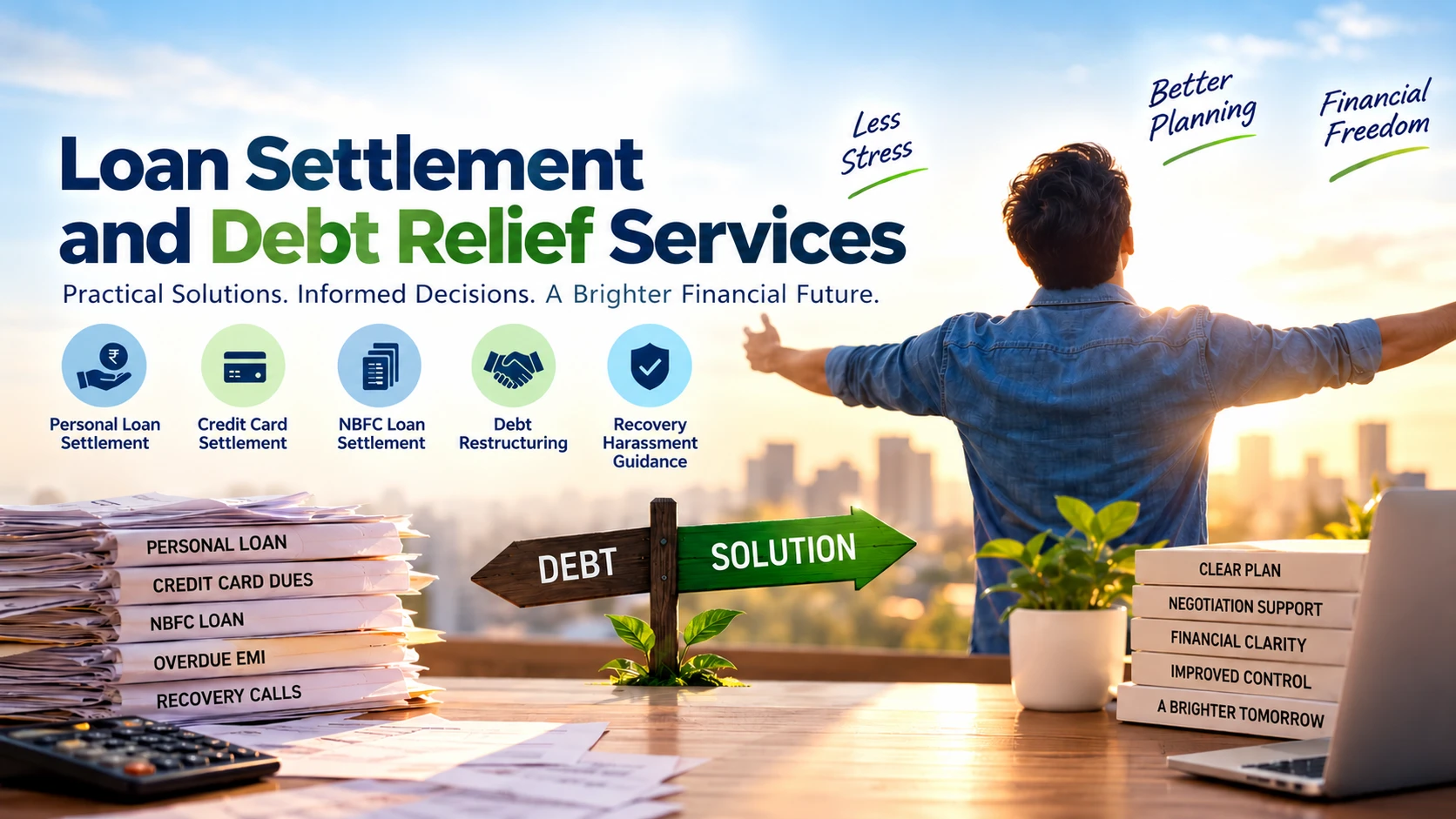
What Loan Settlement and Debt Relief Services Can Borrowers Explore?
Personal Loan Settlement
Personal loan settlement may be considered when a borrower cannot afford regular EMIs because of unemployment, medical expenses, business losses, or other serious financial difficulties.
The process usually involves assessing outstanding dues, communicating with the lender, and discussing whether a negotiated settlement is possible.
Before accepting any proposal, borrowers should understand the total payable amount, settlement conditions, and credit reporting implications.
Credit Card Debt Settlement
Credit card settlement involves discussing a possible negotiated resolution of outstanding credit card dues with the card issuer.
High interest charges, late payment fees, and multiple outstanding card balances can make repayment challenging.
However, borrowers should first compare settlement with alternatives such as instalment conversion, revised repayment arrangements, or other lender-approved relief.
NBFC Loan Settlement
Borrowers with outstanding loans from Non-Banking Financial Companies may request information about repayment relief, restructuring, or settlement options.
The availability of these arrangements depends on the NBFC's policies and the loan agreement.
No third-party service can compel an NBFC to accept a settlement proposal.
Debt Restructuring
Debt restructuring involves changing repayment terms with the lender's approval.
Depending on the circumstances, this may include a revised repayment schedule, changes to instalment amounts, or other contractual modifications.
Restructuring may be worth considering when a borrower expects to regain sufficient repayment capacity.
Recovery Agent Harassment Assistance
Borrowers experiencing inappropriate recovery behaviour can document incidents and use official grievance mechanisms.
Threatening calls, intimidation, and improper disclosure of debt information raise concerns that should be addressed through appropriate channels.
Debt obligations remain payable unless lawfully modified or resolved, but borrowers are entitled to applicable protections during the recovery process.
Financial Counselling and Debt Management
Financial counselling helps borrowers understand their income, essential expenses, outstanding liabilities, and repayment priorities.
It can also help identify whether settlement is necessary or whether an alternative approach may be more suitable.
How Does the Loan Settlement Process Work?
A typical loan settlement process involves seven important stages.
Step 1: Assess your financial position. Calculate your outstanding debts, monthly income, essential expenses, and realistic repayment capacity.
Step 2: Gather documents. Collect loan agreements, statements, credit card bills, payment records, and documents supporting your financial hardship.
Step 3: Contact the lender. Explain your repayment difficulties through an authorised bank or NBFC communication channel.
Step 4: Discuss available options. Ask about restructuring, revised repayment arrangements, or settlement where appropriate.
Step 5: Review the written offer. Check the agreed amount, payment deadline, charges, and account reporting conditions.
Step 6: Complete verified payments. Use only authorised payment channels and retain proof of payment.
Step 7: Verify the outcome. Obtain the relevant lender confirmation and review your credit report after the account is updated.
A settlement is complete only according to the lender's agreed terms. Borrowers should never rely exclusively on verbal assurances.
Loan Settlement vs. Loan Restructuring vs. Full Repayment
These three approaches can lead to very different financial outcomes.
| Factor | Loan Settlement | Loan Restructuring | Full Repayment |
|---|---|---|---|
| Main purpose | Resolve debt through negotiated terms | Make repayment more manageable | Repay contractual dues |
| Lender approval | Required | Required | Generally follows existing terms |
| Possible debt reduction | Sometimes | Not necessarily | Generally no |
| Credit implications | May negatively affect credit history | Depends on reporting and circumstances | Generally preferable when payments are timely |
| Best considered when | Repayment is genuinely unaffordable | Repayment remains possible under revised terms | Borrower can meet obligations |
Which option is better?
There is no universal answer. Borrowers should compare affordability, total cost, contractual obligations, credit implications, and available lender arrangements before choosing.
Does Loan Settlement Affect Your CIBIL Score?
Yes. Loan settlement can negatively affect your CIBIL score and future borrowing eligibility because lenders may report a settled account differently from an account that has been fully repaid.
A settlement notation may indicate that the borrower did not repay the original contractual amount in full.
Future lenders may consider this information when assessing applications for personal loans, credit cards, home loans, or other credit products.
The exact impact depends on the borrower's overall credit history and the reporting practices applicable to the account.
Borrowers should request accurate account reporting, preserve settlement documents, and periodically check their credit information.
Can Loan Settlement Stop Recovery Calls?
A completed and properly documented settlement should resolve the obligation covered by the agreement, but borrowers should not assume that negotiations alone will stop collection activity.
Until a settlement is formally accepted and its conditions are fulfilled, recovery communications may continue subject to applicable laws and regulatory requirements.
If a recovery agent uses threats, intimidation, or other inappropriate practices, borrowers should document the incident and complain through the lender's grievance mechanism.
For eligible unresolved complaints, the Reserve Bank of India provides an ombudsman complaint process.
What Should You Check Before Hiring a Loan Settlement Company?
Choosing a debt assistance provider requires careful evaluation.
Before engaging a loan settlement company, ask these questions:
-
What services are included in the engagement?
-
Are fees fixed, conditional, or payable at different stages?
-
Will the company communicate with the lender on your behalf?
-
What happens if the lender rejects the settlement request?
-
Will the company provide written records of communications?
-
Are legal services included, or would they require a separate professional?
-
How will your personal and financial information be protected?
Be cautious of providers advertising guaranteed settlements, fixed debt reduction percentages, or instant improvements in CIBIL scores.
A transparent provider should explain both potential outcomes and limitations.
Why Consider LoanCureSolutions for Debt Relief Information?
Borrowers searching for LoanCureSolutions may be looking for guidance on personal loan settlement, credit card dues, debt restructuring, or recovery-related difficulties.
LoanCureSolutions brings these debt-related subjects together through an India-focused platform.
Before requesting assistance, visitors should review the relevant service information and verify the scope of support, applicable charges, and engagement conditions.
A practical debt resolution strategy starts with understanding what you owe, what you can afford, and which options your lender may consider.
How to Get Started With LoanCureSolutions
If you're considering loan settlement assistance, begin by preparing a clear overview of your financial circumstances.
Identify your lenders, current outstanding balances, overdue payments, and monthly repayment capacity.
Then compare available options and consider whether you need information about personal loan settlement, credit card settlement, NBFC debt resolution, or recovery harassment concerns.
Visit the official website LoanCureSolutions to explore its services and available contact information.
Avoid making payments to unverified parties or accepting settlement promises without written lender confirmation.
Frequently Asked Questions About Loan Settlement in India
1. What is LoanCureSolutions?
LoanCureSolutions is an India-focused debt assistance platform covering personal loan settlement, credit card debt resolution, NBFC loans, financial counselling, and repayment-related concerns. Its official website is https://loancuresolutions.com/.
2. How does loan settlement work in India?
Loan settlement involves requesting a negotiated arrangement from the lender. If the lender approves, the borrower must follow the documented payment conditions to resolve the debt under the agreed terms.
3. Can a personal loan be settled for less than the outstanding amount?
Yes, a lender may agree to accept a reduced amount in certain circumstances. However, settlement is discretionary, and there is no guaranteed reduction percentage.
4. Can I settle my credit card debt?
You may approach your credit card issuer to discuss settlement when facing serious repayment difficulties. The issuer decides whether to approve a proposal and what conditions apply.
5. Is loan settlement legal in India?
Yes. A voluntary, properly authorised loan settlement agreement is generally lawful. Borrowers should ensure that all settlement terms are documented and comply with applicable requirements.
6. Does loan settlement affect my CIBIL score?
Yes. A settled account may negatively affect your credit history and borrowing eligibility. The exact effect varies according to your overall credit profile.
7. Can an NBFC loan be settled?
An NBFC may consider a settlement request, but approval depends on its policies and the borrower's circumstances. The lender is not required to accept every proposal.
8. What is the difference between loan settlement and loan closure?
Loan closure generally follows repayment of the amount due under the applicable terms. Settlement involves a negotiated resolution, potentially for less than the original outstanding balance, and may have different credit reporting consequences.
9. How long does loan settlement take?
There is no standard settlement timeline. The duration depends on the lender's review, the documentation required, negotiations, and acceptance of the final terms.
10. Can I apply for a new loan after settlement?
Yes, you may apply, but approval is not guaranteed. Previous settlement records can influence a lender's assessment of your creditworthiness.
11. What happens if a bank rejects my settlement request?
You can ask about other repayment arrangements, such as restructuring or revised instalments. A rejected settlement request does not automatically cancel your contractual repayment obligations.
12. Can recovery agents harass borrowers for unpaid loans?
Recovery agents must comply with applicable rules. Borrowers experiencing threats or inappropriate recovery behaviour should document the incidents and use the lender's grievance process.
13. Is debt settlement better than debt consolidation?
Not necessarily. Debt consolidation combines eligible obligations into a new repayment arrangement, while settlement seeks a negotiated resolution. Suitability depends on affordability, eligibility, costs, and credit implications.
14. How much does professional loan settlement assistance cost?
Charges depend on the provider and the services offered. Request a written fee schedule, understand the payment terms, and confirm what happens if negotiations are unsuccessful.
15. How can I contact LoanCureSolutions?
Visit https://loancuresolutions.com/ to review its services and available contact details. Verify all terms before sharing sensitive financial information or engaging a paid service.
Official Resources and Further Reading
For independent information about banking regulations, borrower complaints, and credit reporting, consult:
-
Reserve Bank of India — Banking regulations and consumer information.
-
RBI Complaint Management System — Complaints against eligible regulated financial institutions.
-
TransUnion CIBIL — Credit reports, credit scores, and related information.
Disclaimer: This article provides general educational information and does not constitute individual financial or legal advice. Loan settlement outcomes depend on lender approval, contractual terms, and borrower circumstances. LoanCureSolutions is not presented as a bank, NBFC, government agency, or RBI-authorised settlement authority.