
Real vs. Fake Legal Notice: How to Spot a "WhatsApp Court Order" (2026 Guide)
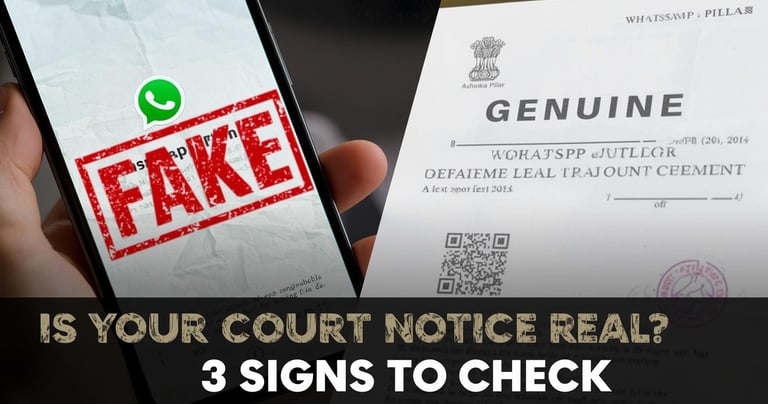
Received a "Court Summons" or "Arrest Warrant" on WhatsApp? It is likely a scam. Learn the 3 signs of a fake legal notice and how to verify any court case online using the government’s eCourts App
Introduction
Your phone buzzes. It’s a WhatsApp message from an unknown number. You open a PDF file, and your heart stops.
It looks like an official court order. It has the National Emblem, a stamp from "Tis Hazari Court" or "Delhi High Court," and a threatening message: “Pay ₹50,000 within 4 hours or an Arrest Warrant will be issued against you.”
Stop. Take a deep breath.
In 99% of cases, this is a Fake Legal Notice created by recovery agents using editing software. It is a psychological trap designed to terrify you into paying immediately.
This guide will teach you how to distinguish between a real court summons and a fake intimidation tactic, and how to verify the truth using official government tools.
1. The "WhatsApp Court" Scam: How It Works
Real Indian courts operate on strict procedural laws. They do not function like recovery agencies.
The Medium: Courts primarily send summons via Speed Post or through a Court Bailiff. While digital summons are becoming possible via email (in specific high-court cases), they never send an "Arrest Warrant" as a forwarded WhatsApp PDF.
The Threat: The police do not issue "warnings" via chat apps. If a warrant is genuine, law enforcement officers will visit your residence directly. They do not negotiate payments over the phone.
Legal Warning: Impersonating a Court Official or Police Officer is a cognizable offense under Section 204 of the Bharatiya Nyaya Sanhita (BNS), 2023.
2. The 3 Signs of a Fake Legal Notice
Examine the document closely. If it contains any of the following "red flags," it is likely a forgery.
Sign #1: The Language of Urgency
The Fake: Uses panic-inducing language like "Pay immediately to avoid arrest," "Last warning," or "Police team dispatched to your location."
The Real: Legal documents use procedural, neutral language. A genuine summons will state: "You are directed to appear before the court on [Date] at [Time]." It rarely, if ever, demands an instant money transfer.
Sign #2: The Payment Method
The Fake: The notice includes a UPI Link, a QR Code, or asks you to deposit money into a personal bank account.
The Real: Courts never collect fines or settlements via WhatsApp. Any court-ordered payment is deposited via the official court registry or directly to the lender's official bank account under a settlement agreement.
Sign #3: Missing "CNR Number"
The Real: Every single court case in India generates a unique 16-digit CNR Number (Case Record Number).
The Fake: Scam notices often feature random "Case Ref Numbers" (e.g., ARB/123/2026) but lack a traceable CNR number.
3. The Acid Test: Verify with "eCourts Services"
Do not rely on guesswork. Verify the existence of the case using the official government database.
1. Download the Tool: Install the eCourts Services app (available on Google Play/App Store) or visit the official website.
2. Search by Party Name:
o Select your State and District (e.g., Maharashtra > Mumbai).
o Click on the "Search by Party Name" tab.
o Enter your name (as the Respondent/Accused).
3. Interpret the Result:
o Record Found: If your name appears with a "Pending" status and a valid CNR number, the case is Real.
o Record Not Found: If no record exists, the notice sent to you is likely Fake.
4. What If It Is an "Arbitration Notice"?
Banks often trigger Arbitration Proceedings to recover dues. These are private dispute resolution processes, not criminal court trials.
Is it Real? Arbitration notices can be genuine even if sent via email/post. They will list the name of an Arbitrator (usually an Advocate).
How to Verify: Search for the Arbitrator's name online. A genuine arbitrator will have a professional presence.
Action Required: You must attend the arbitration hearing (often conducted via video conference). Ignoring it will result in an ex-parte award (a judgment passed in your absence).
5. Action Plan: How to Handle a Fake Notice
Step 1: Do Not Engage Do not call the mobile number listed on the fake notice. That number usually belongs to the scammer, not a court official.
Step 2: File a Cyber Complaint This constitutes cyber fraud and forgery.
Take a screenshot of the WhatsApp message and the fake PDF.
Report the incident on the National Cyber Crime Reporting Portal (cybercrime.gov.in) under the category "Online Fraud" or "Impersonation."
Step 3: Formal Complaint to the Bank The bank is liable for the illegal actions of its recovery agents. Send a formal email to the bank's Nodal Officer:
"I have received forged court documents from your recovery agency. This constitutes criminal forgery under Section 337 (Forgery of Court Record) and impersonation under Section 204 of the BNS. I am filing a formal police complaint regarding these illegal tactics."
Conclusion
Scammers rely on your ignorance of the law. A PDF sent on WhatsApp cannot send you to jail. Only a judge has that power, and a judge will always provide you with an opportunity to be heard.
Received a Notice and Unsure of its Validity? Do not take unnecessary risks. Let our legal experts verify the document for you.
Contact Loancure Solutions For Legal Help
References & Official Sources
1. Verify Court Cases:
o eCourts Services Portal (Govt of India)
o https://services.ecourts.gov.in/
2. Report Cyber Fraud:
o National Cyber Crime Reporting Portal
o [suspicious link removed]
3. Specific BNS Laws (India Code):
o Section 337 BNS (Forgery of Court Record) - India Code Link
o Section 204 BNS (Personating a Public Servant) - India Code Link
Disclaimer
This article is for educational purposes only. If you confirm a legal notice is genuine via the eCourts app, please consult a qualified advocate immediately. Ignoring genuine court summons can lead to serious legal consequences.
© 2024 - 2026 Loancure Solutions. All Rights Reserved.


Email Us - info@loancuresolutions.com
Working Hours - Mon-Sat | 9:00 AM - 9:00 PM
Debt Harassment Relief
Debt Settlement Services
Legal Support
Dispute & Arbitration Handling
Counselling & Financial Management
Privacy Protection & Contact Shielding