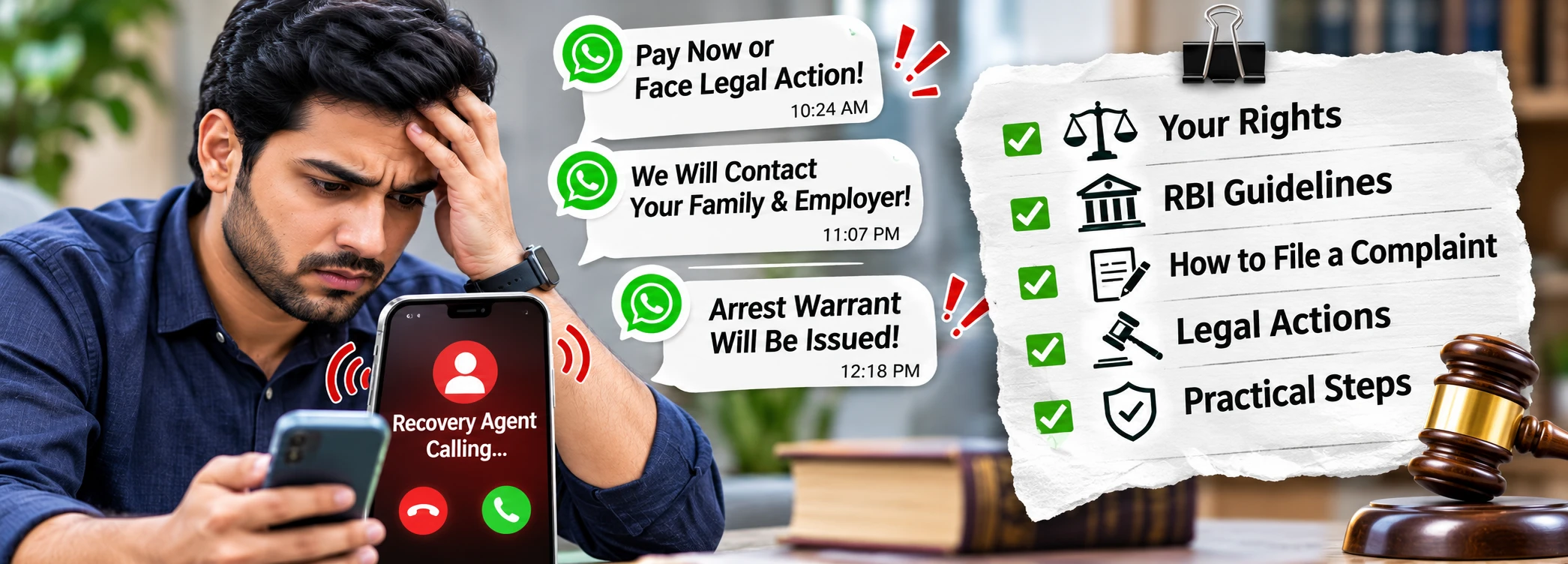
Are loan recovery agents repeatedly calling you, sending threatening WhatsApp messages, or contacting your family about unpaid EMIs? You have rights—even if your loan is overdue.
Imagine receiving 20 calls in one day from different numbers. A recovery agent threatens to contact your employer, shares your loan details with relatives, or sends a WhatsApp message warning of immediate arrest.
For borrowers already facing financial difficulties, this pressure can become overwhelming.
Digital harassment by recovery agents in India may violate RBI guidelines and, depending on the conduct, other applicable laws. Banks and NBFCs have the right to recover legitimate outstanding loans, but recovery must follow lawful and fair procedures.
This guide explains your rights under RBI recovery rules, how to stop unlawful collection practices, where to complain, and what practical action you can take without ignoring genuine repayment obligations.
1. What Is Digital Harassment by Recovery Agents?
Digital recovery harassment occurs when a bank, NBFC, loan app, or its recovery representative uses electronic communication in an intimidating, abusive, intrusive, or otherwise unlawful manner to collect outstanding dues.
It may involve phone calls, WhatsApp messages, SMS, emails, social media, or misuse of personal information.
Common examples
-
Repeated calls intended to intimidate or distress a borrower.
-
Threatening WhatsApp messages about arrest or public humiliation.
-
Sharing loan details with friends, colleagues, or relatives without proper justification.
-
Abusive messages or threats to publish personal photographs.
-
Impersonating police officers, advocates, or court officials.
-
Calling at prohibited hours.
-
Using fake legal notices to demand immediate payments.
Important: A legitimate payment reminder is not automatically harassment. The frequency, content, timing, purpose, and circumstances of communication matter.
2. Is Recovery Agent Harassment Illegal in India?
Yes. Intimidation, harassment, and certain intrusive debt collection practices are prohibited under RBI requirements for regulated lenders.
RBI's August 12, 2022 instructions require covered regulated entities to ensure their recovery agents do not engage in threatening conduct, public humiliation, privacy intrusion, or misleading representations.
These instructions cover several categories of regulated financial institutions, including commercial banks, co-operative banks, NBFCs, asset reconstruction companies, and all-India financial institutions. Microfinance loans have a separate regulatory framework.
The lender remains responsible for complying with applicable requirements when recovery work is outsourced.
Depending on the circumstances, serious threats, impersonation, unauthorized data use, or online abuse may also raise issues under criminal, privacy, or cybercrime laws.
However, not every unpleasant collection call automatically constitutes a criminal offence.
3. RBI Guidelines for Recovery Agent Calls and Messages
Borrowers should understand the basic rules governing debt collection.
| Recovery activity | Applicable protection |
|---|---|
| Calls before 8:00 AM | Prohibited under RBI's 2022 instructions for covered entities |
| Calls after 7:00 PM | Prohibited under those instructions |
| Repeated intimidating calls | Prohibited harassment |
| Threatening WhatsApp messages | May breach RBI requirements |
| Public humiliation | Prohibited recovery conduct |
| Intrusion into relatives' privacy | Prohibited under applicable recovery instructions |
| False arrest or court claims | Misleading representations are prohibited |
| Ordinary payment reminders | Generally permissible when lawful |
Can recovery agents call on Sundays? The RBI's general 2022 instructions do not create a universal Sunday ban. The conduct must still comply with applicable timing, privacy, and anti-harassment requirements.
Different financial products, including certain microfinance loans, may have additional or different rules.
4. Can Recovery Agents Contact Your Family or Employer?
Recovery agents cannot use your family members, friends, or workplace as tools for intimidation or public embarrassment.
For example, sending your outstanding loan balance to colleagues in a WhatsApp group may raise serious confidentiality and harassment concerns.
Similarly, repeatedly calling relatives and threatening to shame them may violate applicable recovery requirements.
There may be limited legitimate reasons to contact another person, such as an authorized co-borrower or guarantor, subject to applicable law and contractual obligations.
However, being listed as an emergency contact does not automatically make someone responsible for repaying your loan.
If an agent contacts your family, document what was disclosed, who received it, and whether threats were made.
5. WhatsApp Harassment by Loan Recovery Agents
WhatsApp has become a common communication channel for loan reminders and collection messages.
However, it can also be misused.
Warning signs include messages threatening immediate arrest, demanding payment to a personal UPI account, sharing edited photographs, or claiming that a police case has already been registered without verifiable details.
What should you do?
First, save the original messages and attached documents.
Next, verify the sender's authorization directly with the lender through its official contact details.
Do not share OTPs, banking passwords, or confidential authentication information.
If a message contains a suspicious payment link, avoid opening it until you have verified the source.
For more information, read our guide on fake legal notices for loan default on WhatsApp.
6. Can Recovery Agents Threaten Arrest for Loan Default?
No recovery agent has the authority to issue an arrest warrant or order the police to arrest a borrower.
Being unable to repay a personal loan or credit card bill is generally a civil matter and does not automatically constitute a criminal offence.
Banks may initiate lawful recovery proceedings, including civil litigation or arbitration where applicable.
Separate criminal proceedings may arise where the legal elements of fraud, cheating, forgery, or another offence are established.
Exceptional civil court-enforcement procedures also involve statutory safeguards.
If someone threatens immediate arrest over a missed EMI, independently verify the claim instead of making a payment under pressure.
7. How to Collect Evidence of Digital Recovery Harassment
Strong documentation can make your complaint clearer and easier to investigate.
Preserve:
-
Call logs: Record dates, times, numbers, and call frequency.
-
WhatsApp messages: Save chats, screenshots, and original attachments.
-
Voice recordings: Preserve recordings obtained lawfully, without editing.
-
Threatening emails: Keep original messages and sender details.
-
Witness information: Note anyone who received threats or improper disclosures.
-
Loan documents: Keep account statements, agreements, and payment receipts.
-
Complaint acknowledgments: Save reference numbers and written responses.
Maintain a chronological record showing what happened, when it happened, and who was involved.
Avoid publishing recovery agents' personal information online or responding with threats.
8. How to File a Complaint Against Recovery Agents
If harassment continues, use the appropriate complaint channels.
Step 1: Complain to your bank or NBFC
Contact the lender's grievance redressal officer through its official website.
Explain the incident, identify the recovery numbers, and attach supporting evidence.
Request an investigation, confirmation of the agent's authorization, and action to stop improper conduct.
Step 2: Escalate to the RBI Ombudsman
If the lender rejects your complaint, provides an unsatisfactory response, or does not respond within 30 days, you may be eligible to approach the RBI Ombudsman.
The Reserve Bank – Integrated Ombudsman Scheme, 2026, effective July 1, 2026, provides a free complaint mechanism for eligible service-related grievances involving covered regulated entities.
File through the official RBI Complaint Management System.
Eligibility and maintainability requirements apply. The Ombudsman does not automatically cancel genuine loan dues.
Step 3: Report cybercrime or serious threats
If the conduct involves suspected online fraud, impersonation, blackmail, or other cybercrime, report it through the National Cyber Crime Reporting Portal.
If you have transferred money in suspected cyber financial fraud, immediately contact your bank and call 1930.
For credible threats of violence or immediate danger, contact the police.
9. Practical Actions to Stop Recovery Harassment
Taking organized action is often more effective than arguing repeatedly with individual callers.
Start by asking the lender to confirm the recovery agency's identity and authorization.
Request that future communications be conducted professionally through verified channels.
Submit a formal written complaint and attach evidence of abusive calls or messages.
Continue monitoring genuine lender communications, court notices, and arbitration proceedings.
You may block or report threatening numbers after preserving evidence, but blocking calls does not remove a legitimate repayment obligation.
If necessary, consult a qualified advocate about legal remedies for threats, harassment, or privacy violations.
10. Can You Take Legal Action Against a Recovery Agent?
Depending on the facts, borrowers may have several remedies.
These can include regulatory complaints, police complaints, civil claims, or other proceedings under applicable law.
The appropriate action depends on the nature of the conduct and the available evidence.
For example, a misleading payment reminder and a credible threat of violence involve very different legal considerations.
A lawyer can help determine whether a particular incident supports a criminal complaint, compensation claim, or another remedy.
Avoid assuming that every RBI guideline violation automatically creates a right to criminal prosecution or financial compensation.
11. What If Your Loan Default Is Genuine?
Recovery harassment and genuine loan liability are separate issues.
Even when an agent behaves unlawfully, the outstanding loan does not automatically disappear.
If you cannot afford your EMIs, request an updated loan statement and evaluate realistic repayment options.
Depending on your lender's policies and financial circumstances, these may include restructuring, revised payment arrangements, or a negotiated one-time settlement.
Before accepting a settlement, obtain written confirmation of the agreed amount, deadline, and treatment of the remaining balance.
Settlement may affect your credit report, and lender approval is required.
For credit card-specific issues, read Credit Card Default in India: Legal Action & Defenses.
12. When Should You Seek Professional Debt Resolution Help?
Professional support may be useful if you are facing several overdue loans, repeated recovery pressure, disputed balances, or difficulty negotiating repayment.
LoanCureSolutions provides information about debt-resolution and loan settlement assistance.
Borrowers can explore available repayment options and seek guidance on communicating with lenders through verified channels.
For formal legal notices, litigation, arbitration, or potential criminal complaints, consult an appropriately qualified advocate.
Struggling with overdue EMIs and recovery pressure? Contact Loan Cure Solutions through its official website to discuss available debt-resolution assistance. Settlement outcomes depend on lender approval and individual circumstances.
Frequently Asked Questions About Recovery Agent Harassment
1. Is digital harassment by recovery agents illegal in India?
Intimidation, harassment, public humiliation, and certain intrusive recovery practices are prohibited under applicable RBI requirements. Other laws may apply depending on the conduct.
2. What are the RBI recovery agent calling hours?
Under RBI's August 2022 instructions for covered regulated entities, recovery calls before 8:00 AM or after 7:00 PM are prohibited. Separate rules may apply to some loan categories.
3. Can recovery agents send WhatsApp messages?
Yes, legitimate recovery communication may occur electronically. However, threatening, misleading, or harassing messages can violate applicable requirements.
4. Can recovery agents call my relatives?
They cannot harass relatives or improperly intrude upon their privacy. Legitimate communication with a guarantor or co-borrower may involve different obligations.
5. Can recovery agents contact my employer?
Contacting an employer to shame, threaten, or improperly disclose loan details may raise serious legal and regulatory concerns.
6. Can a recovery agent arrest me for unpaid EMIs?
No. Recovery agents cannot independently issue arrest warrants or order police arrests.
7. How many times can a recovery agent call daily?
RBI's general 2022 instructions prohibit persistent harassing calls but do not establish one universal numerical daily limit.
8. Can I record threatening recovery calls?
Preserving recordings obtained lawfully may help document harassment. Rules concerning recording, privacy, and admissibility depend on the circumstances.
9. Where can I complain about loan recovery harassment?
Start with your lender's grievance redressal officer. Eligible unresolved complaints may be escalated to the RBI Ombudsman.
10. Can I report WhatsApp recovery threats to cybercrime authorities?
Yes, where the conduct involves suspected cybercrime, such as impersonation, online threats, blackmail, or fraud. Use cybercrime.gov.in.
11. Can recovery agents share my loan details in WhatsApp groups?
Improper disclosure of confidential borrower information or public shaming may violate applicable recovery and privacy requirements.
12. Does filing a harassment complaint cancel my loan?
No. A complaint addresses recovery conduct; it does not automatically extinguish a legitimate debt.
13. Can I block recovery agent numbers?
You may block suspected abusive or fraudulent numbers after preserving evidence, but continue monitoring official lender communications and formal proceedings.
14. Can I get compensation for recovery harassment?
Compensation may be available through appropriate legal or regulatory processes in qualifying cases, but it is not automatic.
15. Can I negotiate loan settlement while reporting harassment?
Yes. You can pursue a complaint about improper conduct while separately discussing repayment or settlement with your lender. Settlement requires lender approval.
Conclusion: Know Your Rights and Take Practical Action
Digital harassment by recovery agents is not something borrowers must accept simply because they have overdue loans.
Banks and NBFCs can recover legitimate debts, but their agents must follow applicable recovery rules and respect borrower privacy.
If you receive threatening calls, abusive WhatsApp messages, or improper disclosures to family members, preserve evidence and raise a written complaint.
Where necessary, escalate the matter through the RBI Ombudsman, cybercrime authorities, police, or appropriate legal channels.
At the same time, address genuine repayment obligations through verified lender communications and realistic financial arrangements.
Facing loan recovery pressure? Understand your rights, document unlawful conduct, and explore responsible repayment options before making decisions under pressure.
Disclaimer: This article provides general educational information about Indian financial regulations and legal remedies as of November 2026. It is not individualized legal advice. The applicability of RBI directions and legal remedies depends on the lender, loan type, conduct, and circumstances.